
Stefano Cataldi, PhD

Neuroscientists at Columbia University and science advocate in the New York City area.


Research

My work in David Sulzer lab includes research on the synaptic basis of normal learning and behavior and how these synapses are involved in nervous system disorders, including neurodegeneration such as Parkinson’s and Huntington’s diseases, neurodevelopmental diseases including autism and schizophrenia, and behavioral disorders such as drug addiction, depression, and post-traumatic stress.

Dorsomedial striatum and motor coordination

It has been suggested that the dorsomedial striatum (DMS) is engaged in the early stages of motor learning for goal-directed actions, whereas at later stages, control is transferred to the dorsolateral striatum (DLS), a process that enables learned motor actions to become a skill or habit. It is not known whether these striatal regions are simultaneously active while the expertise is acquired. To address this question, we developed a mouse “Treadmill Training Task” that tracks changes in mouse locomotor coordination during running practice and simultaneously provides a means to measure local neuronal activity using photometry. To measure change in motor coordination over treadmill practice sessions, we used DeepLabCut (DLC) and custom-built code to analyze body position and paw movements. By evaluating improvements in motor coordination during training with simultaneous neuronal calcium activity in the striatum, we found that DMS direct pathway neurons exhibited decreased activity as the mouse gained proficiency at running. In contrast, direct pathway activity in the DLS was similar throughout training. Pharmacological blockade of D1 dopamine receptors in these subregions during task performance demonstrated that dopamine neurotransmission in the direct pathway activity is necessary for efficient motor coordination learning. These results provide new tools to measure changes in fine motor skills with simultaneous recordings of brain activity and reveal fundamental features of the neuronal substrates of motor learning.

Ventral striatum and reward processing

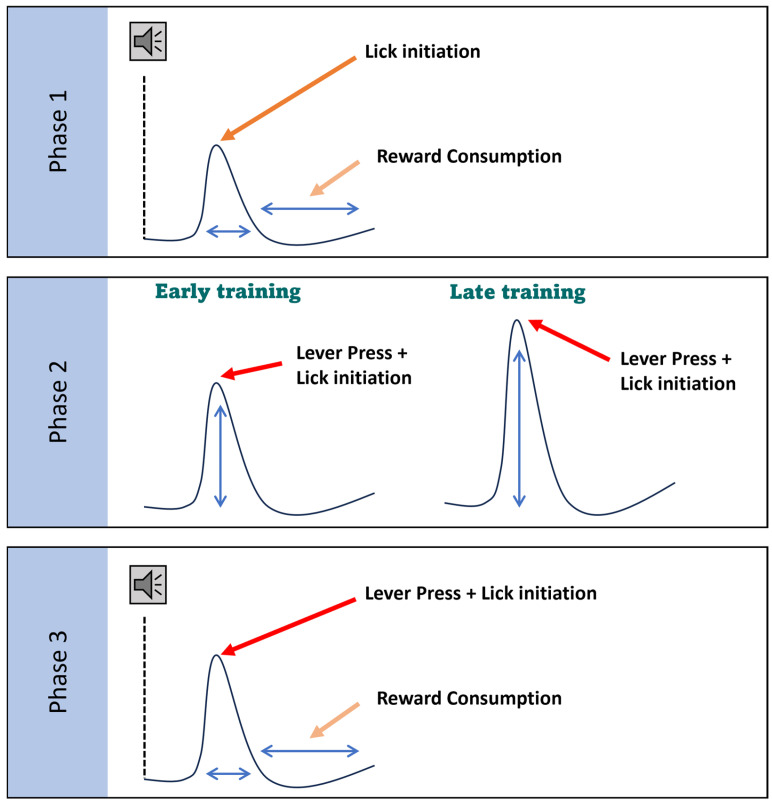
 Learning is classically modeled to consist of an acquisition period followed by a mastery period when the skill no longer requires conscious control and becomes automatic. Dopamine neurons projecting to the ventral striatum (VS) produce a teaching signal that shifts from responding to rewarding or aversive events to anticipating cues, thus facilitating learning. However, the role of the dopamine-receptive neurons in the ventral striatum, particularly in encoding decision-making processes, remains less understood. Here, we introduce an operant conditioning paradigm using open-source microcontrollers to train mice in three sequential learning phases. Phase I employs classical conditioning, associating a 5 s sound cue (CS) with a sucrose-water reward. In Phase II, the CS is replaced by a lever press as the requirement for reward delivery, marking an operant conditioning stage. Phase III combines these elements, requiring mice to press the lever during the CS to obtain the reward. We recorded calcium signals from direct pathway spiny projection neurons (dSPNs) in the VS throughout the three phases of training. We find that dSPNs are specifically engaged when the mouse makes a decision to perform a reward-seeking action in response to a CS but are largely inactive during actions taken outside the CS. These findings suggest that direct pathway neurons in the VS contribute to decision-making in learned action-outcome associations, indicating a specialized role in initiating operant behaviors.